
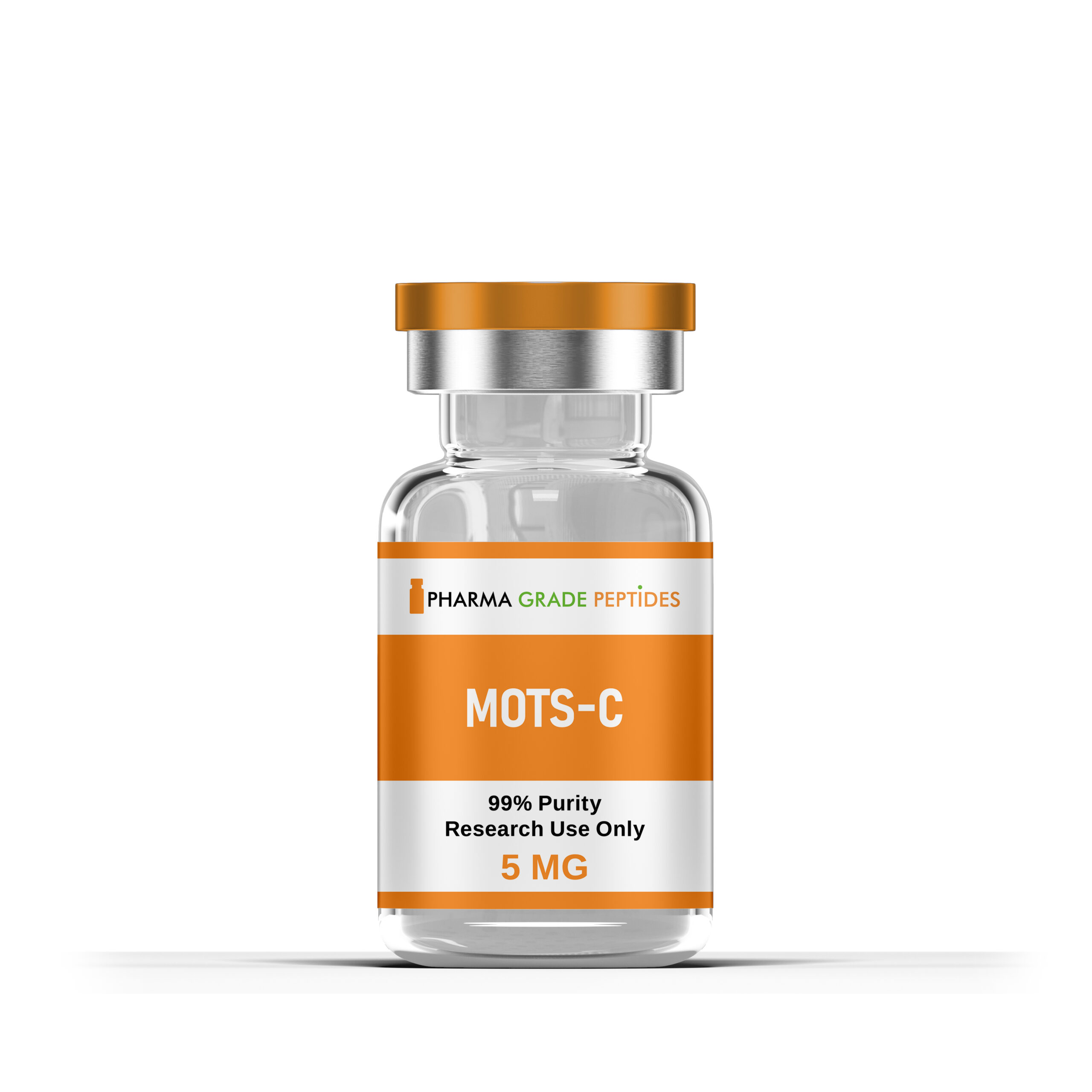
MOTS-C 5mg – Premium Research Grade
Mitochondria-Derived Peptide | Mitochondrial-Nuclear Signalling Research Compound | ≥99% Purity | HPLC-Tested | Lyophilized Powder
Product Overview
MOTS-C (Mitochondrial Open Reading Frame of the 12S rRNA-c) is a 16-amino acid peptide with a uniquely important distinction in the peptide research landscape — it is encoded by mitochondrial DNA rather than nuclear DNA, making it one of a rare class of mitochondria-derived peptides (MDPs) that have only recently been characterised in scientific literature. This 5mg research-grade formulation provides laboratories with a high-purity, HPLC-verified compound for investigating AMPK signalling pathways, mitochondria-to-nucleus communication, cellular metabolic stress responses, glucose and lipid metabolism regulation, and insulin sensitivity mechanisms in controlled experimental models.
MOTS-C’s mitochondrial DNA origin and its ability to translocate from mitochondria to the nucleus under metabolic stress conditions represent a fundamentally novel area of cell biology research — the study of mitochondrial retrograde signalling and how mitochondria communicate metabolic status to the nuclear genome. This positions MOTS-C as one of the most scientifically significant emerging research compounds in metabolic biology, occupying research territory distinct from any other compound in our catalog.
What is MOTS-C and Why is it Researched?
MOTS-C was first identified in 2015 by researchers at the University of Southern California, who discovered it encoded within the mitochondrial 12S rRNA gene — a region previously considered non-coding for peptides. This discovery challenged established understanding of mitochondrial DNA function and opened an entirely new field investigating mitochondria-derived peptides as biological signalling molecules.
The significance of MOTS-C’s mitochondrial origin lies in what it reveals about cellular communication. Unlike nuclear-encoded peptides, MOTS-C is produced directly in the mitochondria — the cell’s primary energy-producing organelles — and can translocate to the nucleus in response to metabolic stress signals. This mitochondria-to-nucleus communication pathway represents a previously unknown feedback mechanism through which cells monitor and respond to their own energy status, making MOTS-C a central research tool for understanding cellular metabolic homeostasis at a fundamental level.
Mechanism of Action
MOTS-C exerts its research-relevant biological activity through interconnected metabolic signalling pathways:
AMPK Pathway Activation — MOTS-C’s most extensively studied mechanism is its activation of AMP-activated protein kinase (AMPK) — the master cellular energy sensor. AMPK activation by MOTS-C triggers downstream signalling that promotes glucose uptake, fatty acid oxidation, and mitochondrial biogenesis while suppressing anabolic pathways that consume cellular energy. Researchers use MOTS-C to study how mitochondria-derived signals regulate AMPK-mediated metabolic adaptation.
Mitochondria-to-Nucleus Translocation — Under conditions of metabolic or oxidative stress, MOTS-C translocates from the mitochondria to the nucleus, where it interacts with nuclear transcription factors and influences gene expression programmes related to metabolic regulation. Researchers investigate this translocation mechanism as a model for studying mitochondrial retrograde signalling — how mitochondria communicate their functional status to the nuclear genome.
Glucose Metabolism & Insulin Sensitivity Research — MOTS-C has been studied in research models for its effects on cellular glucose handling, GLUT4 translocation, and insulin signalling pathway activity. Its AMPK-mediated effects on glucose metabolism make it relevant for researchers studying insulin sensitivity mechanisms and metabolic adaptation responses.
Cellular Stress Response & Mitohormesis — MOTS-C is activated under conditions of mitochondrial stress and plays a role in the mitohormesis response — the adaptive cellular process by which mild mitochondrial stress triggers protective metabolic adaptations. Researchers use MOTS-C to investigate how mitochondria-derived stress signals coordinate cellular metabolic resilience.
Lipid Metabolism Modulation — MOTS-C influences lipid oxidation pathways through AMPK activation and direct effects on fatty acid metabolism gene expression. Researchers studying lipid metabolism regulation and the interface between mitochondrial function and adipose tissue biology use MOTS-C alongside compounds in our GLP-1 & weight loss category for complementary metabolic pathway investigations.
Research Applications
MOTS-C 5mg is suited for laboratory investigations including:
- Mitochondria-derived peptide biology and mitochondrial DNA-encoded signalling research
- AMPK pathway activation and cellular energy sensing mechanism studies
- Mitochondria-to-nucleus retrograde signalling and translocation research
- Cellular metabolic stress response and mitohormesis pathway investigations
- Glucose metabolism, GLUT4 translocation, and insulin sensitivity studies
- Lipid oxidation and fatty acid metabolism pathway research
- Mitochondrial function, efficiency, and biogenesis signalling studies
- Comparative metabolic research alongside GLP-1 compounds in our GLP-1 & weight loss category
Product Specifications
| Property | Detail |
|---|---|
| Peptide Type | Mitochondria-derived peptide (MDP) |
| Encoding DNA | Mitochondrial DNA (12S rRNA gene) |
| Quantity | 5mg per vial |
| Amino Acid Length | 16 amino acids |
| Primary Pathway | AMPK signalling activation |
| Form | Lyophilized powder |
| Purity | ≥99% (HPLC verified) |
| Category | GLP-1 & metabolic research |
| Storage | -20°C long-term, 4°C short-term |
Storage & Reconstitution
Store lyophilized MOTS-C at -20°C for long-term stability or at 4°C for use within 4–6 weeks. Protect from light and moisture at all times and keep vials tightly sealed until ready for use. Reconstitute with bacteriostatic water under sterile laboratory conditions. All reconstitution supplies are available in our accessories category.
Frequently Asked Questions — MOTS-C 5mg
What is MOTS-C used for in research? MOTS-C is used in laboratory research to investigate AMPK signalling pathway activation, mitochondria-to-nucleus retrograde communication, cellular metabolic stress responses, glucose metabolism and insulin sensitivity mechanisms, lipid oxidation pathways, and mitohormesis biology. Its unique mitochondrial DNA origin makes it a foundational research compound for studying mitochondria-derived peptide signalling.
Why is MOTS-C’s mitochondrial DNA origin scientifically significant? The vast majority of cellular proteins and peptides are encoded by nuclear DNA. MOTS-C is encoded by mitochondrial DNA — a separate genome within the cell that was previously thought to encode only transfer RNAs, ribosomal RNAs, and a small number of oxidative phosphorylation proteins. Its discovery as a bioactive signalling peptide encoded by mitochondrial DNA opened an entirely new field of research into mitochondria-derived peptides and mitochondrial retrograde signalling.
What is AMPK and why is it central to MOTS-C research? AMP-activated protein kinase (AMPK) is the master cellular energy sensor — a kinase that activates when cellular energy (ATP) levels fall and AMP/ATP ratios rise. AMPK activation triggers metabolic adaptations that restore energy balance including glucose uptake promotion, fatty acid oxidation, and mitochondrial biogenesis. MOTS-C’s ability to activate AMPK through a mitochondria-derived signal makes it a unique research tool for studying how cells sense and respond to their own energy status.
How does MOTS-C translocate to the nucleus? Under metabolic or oxidative stress conditions, MOTS-C moves from the mitochondria to the nucleus through mechanisms that are still being characterised in current research literature. Once in the nucleus, it interacts with transcription factors and influences gene expression programmes related to metabolic regulation — a process researchers are actively investigating as a novel mitochondrial retrograde signalling pathway.
What does the 5mg quantity refer to? Each vial contains 5mg of lyophilized MOTS-C peptide — a standard research quantity designed to support multiple experimental protocols within a single laboratory supply.
What purity level is your MOTS-C? Every batch is HPLC-tested to ≥99% purity. Certificates of Analysis are available on request for all orders.
Do you offer bulk pricing on MOTS-C? Yes. Bulk discounts are available for research institutions and laboratories. Contact us directly for volume pricing details.
For research and laboratory use only. Not intended for human or veterinary consumption. Not for use in the diagnosis, treatment, cure, or prevention of any disease.





Reviews
There are no reviews yet.