
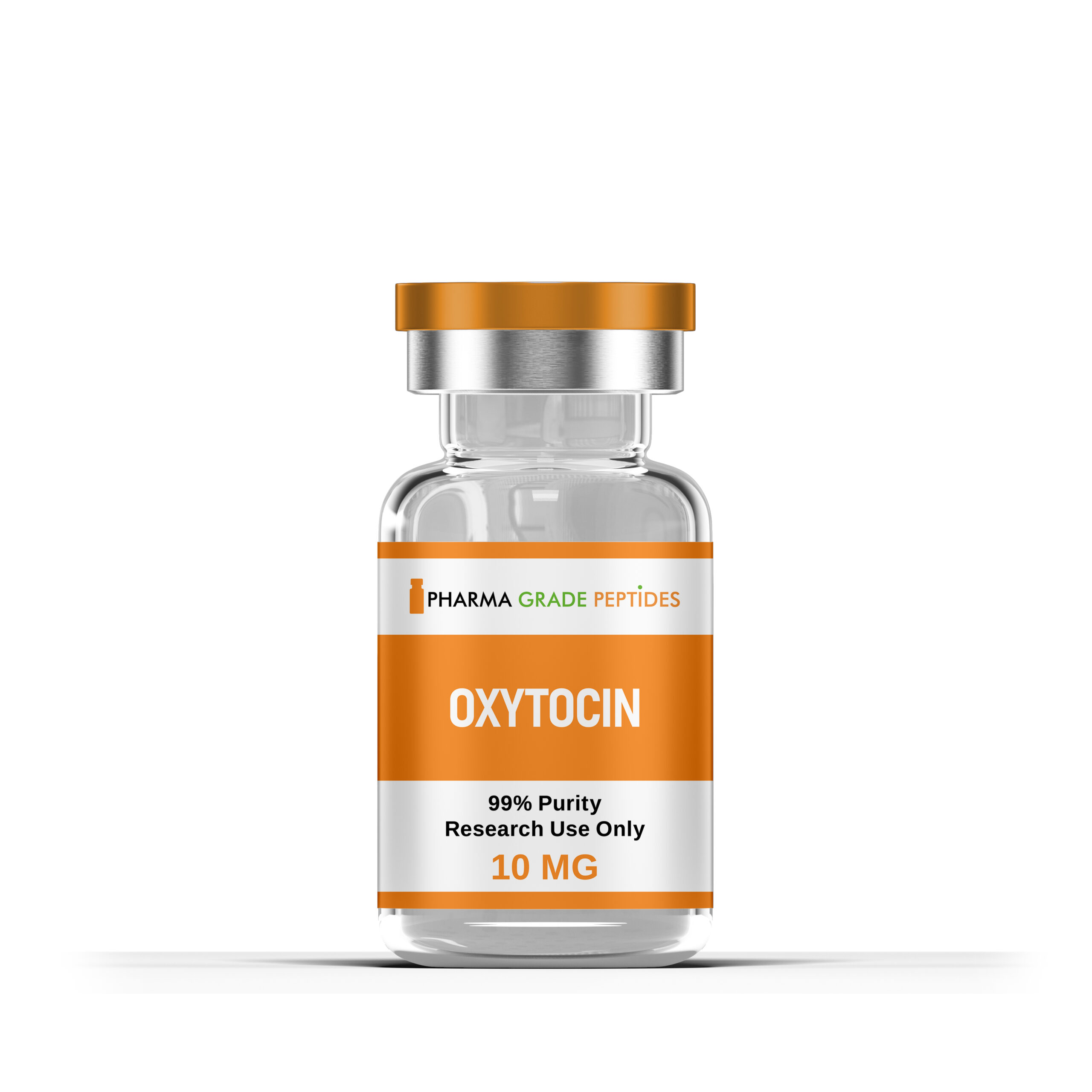
Oxytocin 10mg – Premium Research Grade
Hypothalamic Neuropeptide Hormone | Social & Neuroendocrine Research Compound | ≥99% Purity | HPLC-Tested | Lyophilized Powder
Product Overview
Oxytocin is a naturally occurring nonapeptide hormone synthesised in the paraventricular and supraoptic nuclei of the hypothalamus and released by the posterior pituitary gland. This 10mg research-grade formulation provides laboratories with a high-purity, HPLC-verified compound for investigating social behaviour neurobiology, stress-response modulation, neuroendocrine signalling, reproductive physiology pathways, and oxytocin receptor pharmacology in controlled experimental models.
As one of the most extensively studied neuropeptide hormones in behavioural neuroscience, oxytocin occupies a unique position at the intersection of neurobiology, endocrinology, and social psychology research. Its dual role as both a peripheral hormone — regulating reproductive physiology — and a central neuromodulator — influencing social cognition and emotional processing — makes it one of the most multifaceted research compounds available across all categories of peptide science.
What is Oxytocin and Why is it Researched?
Oxytocin’s research significance spans multiple disciplines. Originally studied for its peripheral roles in uterine contractility and lactation, subsequent decades of neuroscience research revealed oxytocin’s central role as a neuromodulator of social behaviour, emotional regulation, trust, and affiliative responses — earning it significant attention in behavioural neuroscience and neuropsychiatry research.
Oxytocin exerts its effects through oxytocin receptors (OXTRs) — G protein-coupled receptors expressed throughout the brain (amygdala, hypothalamus, nucleus accumbens, prefrontal cortex) and in peripheral tissues including the uterus, mammary glands, heart, and gastrointestinal tract. This broad receptor distribution gives oxytocin research relevance across neuroscience, reproductive biology, cardiovascular physiology, and stress response research simultaneously.
Mechanism of Action
Oxytocin exerts its research-relevant biological activity through receptor-mediated signalling across multiple tissue systems:
Central Oxytocin Receptor Signalling — In the CNS, oxytocin binds OXTRs expressed on neurons in the amygdala, hypothalamus, and prefrontal cortex, modulating GABAergic and glutamatergic neurotransmission. Researchers use oxytocin to investigate how neuropeptide signals influence fear responses, social recognition, trust behaviour, and emotional processing in neurobiological research models.
HPA Axis & Stress Response Modulation — Oxytocin interacts with the hypothalamic-pituitary-adrenal (HPA) axis, inhibiting cortisol secretion and modulating stress-response signalling. Research models use oxytocin to study how neuropeptide-mediated HPA axis modulation influences anxiety-related pathways and stress resilience mechanisms — complementing research conducted with Selank and DSIP.
Dopamine & Reward Pathway Interaction — Oxytocin modulates dopaminergic signalling in the nucleus accumbens and ventral tegmental area — brain regions central to reward processing and social motivation. Researchers investigate these interactions to understand how oxytocin shapes social reward pathways and affiliative behaviour neurobiology.
Reproductive & Peripheral Physiology Research — Peripherally, oxytocin acts on uterine smooth muscle, mammary gland myoepithelial cells, and cardiovascular tissue through OXTR activation. Researchers studying reproductive physiology, lactation pathways, and peripheral neuroendocrine signalling use oxytocin as the primary reference compound for OXTR-mediated peripheral tissue responses.
Research Applications
Oxytocin 10mg is suited for laboratory investigations including:
- Social bonding, trust, and affiliative behaviour neurobiology research
- Amygdala and prefrontal cortex oxytocin receptor pharmacology studies
- HPA axis modulation and stress-response pathway investigations
- Dopaminergic reward pathway and social motivation research
- Reproductive physiology and uterine contractility pathway studies
- Lactation and mammary gland signalling research
- Comparative neuroendocrine studies alongside other CNS compounds in our cognitive peptides category
- Intranasal peptide delivery and CNS bioavailability research models
Product Specifications
| Property | Detail |
|---|---|
| Peptide Type | Hypothalamic nonapeptide hormone |
| Quantity | 10mg per vial |
| Amino Acid Length | 9 amino acids (with disulfide bridge) |
| Target Receptor | Oxytocin receptor (OXTR) |
| Form | Lyophilized powder |
| Purity | ≥99% (HPLC verified) |
| Category | Sexual health & wellness research |
| Storage | -20°C long-term, 4°C short-term |
Storage & Reconstitution
Store lyophilized Oxytocin at -20°C for long-term stability or at 4°C for use within 4–6 weeks. Protect from light and moisture at all times and keep vials tightly sealed until ready for use. Oxytocin contains a disulfide bridge between cysteine residues 1 and 6 — handle with care during reconstitution to preserve structural integrity. Reconstitute with bacteriostatic water under sterile laboratory conditions. All reconstitution supplies are available in our accessories category.
Frequently Asked Questions — Oxytocin 10mg
What is Oxytocin used for in research? Oxytocin is used in laboratory research to investigate social behaviour neurobiology, oxytocin receptor pharmacology, HPA axis stress-response modulation, dopaminergic reward pathway interactions, reproductive physiology signalling, and neuroendocrine communication. It is one of the most multidisciplinary neuropeptide research compounds available.
Why is Oxytocin called the “bonding hormone” in research literature? Oxytocin earned this description through decades of research demonstrating its role in facilitating social recognition, trust, and affiliative behaviour in experimental models. CNS oxytocin signalling in the amygdala and nucleus accumbens modulates fear responses and social reward pathways — mechanisms central to understanding the neurobiology of social bonding and cooperative behaviour.
How is Oxytocin administered in research protocols? Oxytocin research protocols commonly use intranasal administration to facilitate CNS delivery, taking advantage of the olfactory and trigeminal pathways that allow peptides to bypass the blood-brain barrier. Peripheral administration routes are also used depending on whether central or peripheral receptor effects are the research focus.
What is the structural feature that makes Oxytocin unique? Oxytocin contains a disulfide bridge between its cysteine residues at positions 1 and 6, forming a cyclic ring structure that is essential for receptor binding activity. This disulfide bond distinguishes it structurally from linear peptides and requires careful handling during reconstitution to preserve biological activity.
What purity level is your Oxytocin? Every batch is HPLC-tested to ≥99% purity. Certificates of Analysis are available on request for all orders.
How should Oxytocin be stored? Store at -20°C for long-term use or at 4°C for short-term use within 4–6 weeks. Keep away from light and moisture and store in a sealed vial until reconstitution.
Do you offer bulk pricing on Oxytocin? Yes. Bulk discounts are available for research institutions and laboratories. Contact us directly for volume pricing details.
For research and laboratory use only. Not intended for human or veterinary consumption. Not for use in the diagnosis, treatment, cure, or prevention of any disease.

Reviews
There are no reviews yet.